
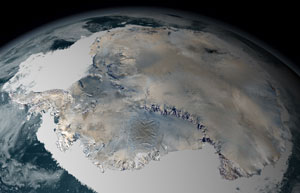
Climate scientists say the link between declining CO2 levels in the Earth’s atmosphere and the formation of the Antarctic ice caps some 34 million years ago has been confirmed for the first time. The scientists, from Cardiff, Bristol and Texas A&M universities, worked in a small East African village where they measured the CO2levels in ancient microfossils.
The study’s findings, published in Nature, confirm that atmospheric CO2 declined during the Eocene-Oligocene climate transition and that the Antarctic ice sheet began to form when CO2 in the atmosphere reduced to a tipping point of around 760 parts-per-million.
“About 34 million years ago the Earth experienced a mysterious cooling trend. Glaciers and small ice sheets developed in Antarctica, sea levels fell and temperate forests began to displace tropical-type vegetation in many areas. The period, known to geologists as the Eocene-Oligocene transition, culminated in the rapid development of a continental-scale ice sheet on Antarctica,” explained Cardiff University’s Paul Pearson, who led the study.
To investigate further, the researchers set out to establish whether there was a substantial decline in atmospheric carbon dioxide levels as the Antarctic ice sheet began to grow. They mapped large expanses of bush and wilderness and pieced together the underlying local rock formations using occasional outcrops of rocks and stream beds.
“By using the rather unique set of samples from Tanzania and a new analytical technique, we have, for the first time, been able to reconstruct the concentration of CO2 across the Eocene-Oligocene boundary – the time period about 34 million years ago when ice sheets first started to grow on Eastern Antarctica,” said researcher Gavin Foster.
The new findings offer important lessons for the future and will add to the debate around rising CO2 levels in the earth’s atmosphere as the world’s attention turns to on UN Climate Conference, which opens in Copenhagen later this year.
Related:
Global warming estimates “fundamentally wrong,” contends new study
CO2 behind prehistoric global cooling
Climate “Tipping Points” Identified
CO2 Rocketing, Carbon Sinks Failing
Source: Cardiff University
Related posts:
 Biofuels could be made directly from excess CO2 in the atmosphere, say scientists
 Carbon emission levels from deforestation challenged
 Rising CO2 levels creating crazy fish
 “Profound” plant water cycle changes add new wildcard to climate change guesstimates
 BPA levels in US foods assessed for first time
 Carbon impacts get major revision











Comments are closed.