Home   |   Sci News   |   Discussion Forum   |   Books, Books, Books   |   Curiosity Shop
Discussion Forums
General Science

Not-Quite Science

Physics

Climate Change

Science Fiction

Past Forums

Search
Custom Search
Sponsored Links
News And Research

Animal Kingdom

Biology

Climate Change

Environment

Evolution

Genetics

Humans

Mind & Brain

Prehistory

Health & Diet

Health Threats

Health & Environment

Health: From The Lab

Mental Health

Reproductive Health

Energy Alternatives

Chemistry

Computing & Electronics

Nanotechnology

Pimping Nature

Robotics & AI

Physics

Space


Science Shopping
Sci Shop
Peculiar and bizarre scientific stuff that you didn't even know existed and you don't need.
Science Books
Book Reviews
Rusty Rockets lists his all-time favorite science titles.
Archives
2010
2009 2008 2007
2006 2005 2004
2003 2002 2001
2000 1999 1998
Feature Archive

Bookmark and Share


7 September 2009
Far out: measuring GDP from orbit
by Kate Melville

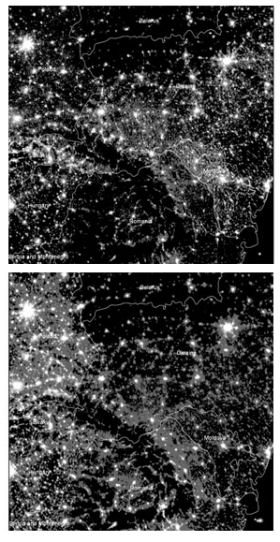
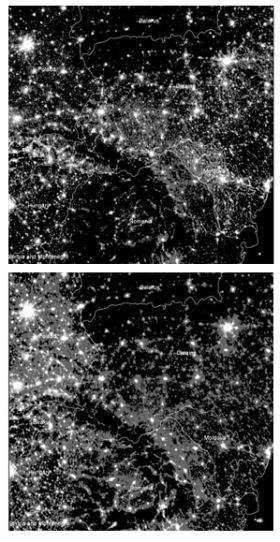
Outer space offers a new way for measuring economic growth, according to a new working paper by three Brown University economists. In their paper, J. Vernon Henderson, Adam Storeygard and David N. Weil suggest a new framework for estimating a region's gross domestic product (GDP) by using satellite images of the area's nighttime lights.

(Pic: Increased nighttime lighting in Poland (top left quarter of each pic) and Eastern Europe between 1992 and 2002. Poland is in the top left quarter of each image.)

Illustrating the lack of precision in traditionally compiled figures, the authors cite the Penn World Tables, which show the growth figures from sub-Saharan African countries to have a 30-40 percent margin of error.

To improve accuracy, the researchers suggest combining measured income data with the changes observed in a country's "night lights" as seen from space. Using satellite picture composites, they look at changes in a region's light density over a 10-year period. "Consumption of nearly all goods in the evening requires lights," they write. "As income rises, so does light usage per person, in both consumption activities and many investment activities."

When the researchers applied the new methodology to countries with low-quality national income data, the new estimates were significantly different. For example, in the Democratic Republic of Congo, lights suggest a 2.4 percent annual growth rate in GDP, while official estimates suggest a negative 2.6 percent growth over the same time period. At the other end of the spectrum, Myanmar has an official growth rate of 8.6 percent a year, but the lights data imply only a 3.4 percent annual growth rate.

The team say they don't envision the lights density data as a replacement for official numbers, but when added to existing data from agencies like the World Bank, the lights density can provide a better indicator of how these economies really are performing. "Our hope is that people start using this, either when they don't have actual data on economic growth or when the numbers are pretty bad," said Henderson.

Related:
Academics question surge's success in Baghdad

Source: Brown University


Discuss this article in our forum

Home         All The News      Science Forum         Books, Books, Books         Curiosity Shop         About

The terms and conditions governing your use of this website.
Copyright © 1997 - 2010 Science a Go Go and its licensors. All rights reserved.