
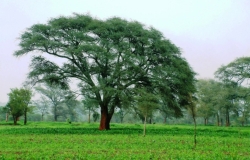
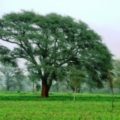
A type of acacia tree with an unusual growth habit – unlike virtually all other trees – holds particular promise for farmers in Africa as a free source of nitrogen for their soils that could last generations.
With its nitrogen-fixing qualities, the long-lived acacia tree, Faidherbia albida, could minimize the use of fertilizers; provide fodder for livestock, wood for construction and fuel wood, and medicine through its bark, as well as windbreaks and erosion control to farmers across sub-Saharan Africa. The tree is adapted to an incredibly wide array of climates and illustrates the benefits of growing trees on farms, said scientists at the 2nd World Congress of Agroforestry.
“The future of trees is on farms,” said Dennis Garrity, Director General of the World Agroforestry Centre. “Growing the right tree in the right place on farms in sub-Saharan Africa-and worldwide- has the potential to slow climate change, feed more people, and protect the environment. This tree, as a source of free, organic nitrogen, is an example of that.”
The Faidherbia acacia tree has the quality of “reverse leaf phenology,” which drives the tree to go dormant and shed its nitrogen-rich leaves during the early rainy season – when seeds are being planted and need the nitrogen – and then to re-grow its leaves when the dry season begins and crops are dormant. This makes it highly compatible with food crops because it does not compete with them for sunlight – only the bare branches of the tree’s canopy spread overhead while crops grow to maturity. Additionally, their leaves and pods provide a crucial source of fodder in the dry season for livestock when other plants have dried up.
The conference was told that in Malawi, maize yields were increased up to 280 percent in the zone under the tree canopy compared with the zone outside the tree canopy. In Zambia, recent unpublished observations showed that unfertilized maize yields in the vicinity of the Faidherbia trees averaged 4.1 tonnes per hectare, compared to 1.3 tonnes nearby but beyond the tree canopy.
There are some 700 published references to the tree’s history, ecology and growing habits, but according to Garrity, much of the knowledge is farmer-driven. “We are now combining the scientific knowledge base with the farmer knowledge base. There is sufficient research on both sides to warrant dramatically scaling-up the planting of this tree on farms across Africa through extension programs. The risks to farmers are low; it requires very little labor, and delivers many benefits,” he said.
Related:
Organic Carbon Declines In Fertilized Soils
Down On The Farm? Yields, Nutrients And Soil Quality
Study Slams Mainstream Farming Techniques
Source: World Agroforestry Centre
Related posts:
 Could tainted cookware be poisoning an entire continent?
 Massive decline in food crop diversity threatens global food security
 Hunting humans imitate honeybees
 Ecotourism wildcard in African disease cocktail
 Evidence for HIV in humans in distant past
 Evergreen agriculture emerges as Africa’s key to food security











Comments are closed.