
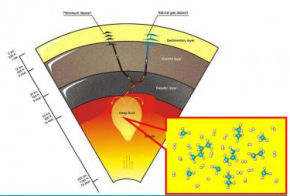
It’s generally agreed that the oil that fuels our cars started out as living organisms that died and were compressed and heated under layers of sediment in the Earth’s crust. But scientists have debated for years whether some of these hydrocarbons could also have been created deeper in the Earth and formed without organic matter.
Now, scientists have found that ethane and heavier hydrocarbons can be synthesized under the pressure-temperature conditions of the upper mantle – the layer of Earth under the crust and on top of the core. The research, conducted by scientists at the Carnegie Institution’s Geophysical Laboratory along with researchers from Russia and Sweden, appears in Nature Geoscience.
Methane (CH4) is the main constituent of natural gas, while ethane (C2H6) is used as a petrochemical feedstock. Both of these hydrocarbons, and others associated with fuel, are known as saturated hydrocarbons because they have simple, single bonds and are saturated with hydrogen. Using a diamond anvil cell and a laser heat source, the scientists first subjected methane to pressures exceeding 20 thousand times the atmospheric pressure at sea level and temperatures ranging from 1,300 F to over 2,240 F.
“We were intrigued by previous experiments and theoretical predictions,” said Carnegie’s Alexander Goncharov, one of the study’s coauthors. “Experiments reported some years ago subjected methane to high pressures and temperatures and found that heavier hydrocarbons formed from methane under very similar pressure and temperature conditions. However, the molecules could not be identified and a distribution was likely. We overcame this problem with our improved laser-heating technique where we could cook larger volumes more uniformly. And we found that methane can be produced from ethane.”
The notion that hydrocarbons generated in the mantle migrate into the Earth’s crust and contribute to oil-and-gas reservoirs was mooted in Russia many years ago. The researchers say the synthesis and stability of hydrocarbons over the full range of conditions within the Earth’s mantle now needs to be explored. “In addition, the extent to which this ‘reduced’ carbon survives migration into the crust needs to be established [without being oxidized to CO2]. These and related questions demonstrate the need for a new experimental and theoretical program to study the fate of carbon in the deep Earth,” say the scientists.
Related:
Under Pressure: Earth Science (Part II)
Ancient Meteorite Turned Earth Inside Out















Comments are closed.