
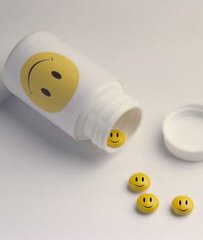
Placebos – sugar pills designed to represent “no treatment” in a clinical treatment study – work nearly as well as the actual medication for some people. Why this should be so remains a mystery, but researchers at UCLA believe they have found a possible explanation: genetics.
Dr. Andrew Leuchter, a UCLA professor of psychiatry, and colleagues report that in people suffering from major depressive disorder (MDD), genes that influence the brain’s reward pathways may modulate the response to placebos. The research appears in the Journal of Clinical Psychopharmacology.
Placebos are thought to act by stimulating the brain’s central reward pathways by releasing “feel good’ neurotransmitters called monoamines, specifically dopamine and norepinephrine. Because the chemical signaling done by monoamines is under strong genetic control, the scientists reasoned that common genetic variations between individuals – called genetic polymorphisms – could influence the placebo response.
To test this theory, the researchers took blood samples from 84 people diagnosed with MDD; 32 were given medication and 52 a placebo. The researchers looked at the polymorphisms in genes that coded for two enzymes that regulate monoamine levels: catechol-O-methyltransferase (COMT) and monoamine oxidase A (MAO-A). Subjects with the highest enzyme activity within the MAO-A polymorphism had a significantly lower placebo response than those with other genotypes. With respect to COMT, those with lower enzyme activity within this polymorphism had a lower placebo response.
The researchers stressed that this is not the sole explanation for a response to a placebo, which is likely to be caused by many factors, both biological and psychosocial. “But the data suggests that individual differences in response to placebo are significantly influenced by individual genotypes,” Leuchter said. Including the influence of genotype in the design of clinical trials could facilitate more accurate testing of future treatments, he added.
Related:
Expensive Placebo Works Better Than Cheap One
Placebo As Effective As Prozac
Ritual A Critical Element Of Placebo Effect
Placebo Surgery Shows Surprising Results





Comments are closed.