Home   |   Sci News   |   Discussion Forum   |   Books, Books, Books   |   Curiosity Shop
Discussion Forum
Science Talk
Discuss scientific conundrums with our band of bamboozled boffins.
Search
Custom Search
Sponsored Links
Science Shopping
Sci Shop
Peculiar and bizarre scientific stuff that you didn't even know existed and you don't need.
News And Research

Animal Kingdom

Biology

Climate Change

Environment

Evolution

Genetics

Humans

Mind & Brain

Prehistory

Health & Diet

Health Threats

Health & Environment

Health: From The Lab

Mental Health

Reproductive Health

Energy Alternatives

Chemistry

Computing & Electronics

Nanotechnology

Pimping Nature

Robotics & AI

Physics

Space


Science Books
Book Reviews
Rusty Rockets lists his all-time favorite science titles.
Archives
2009 2008 2007
2006 2005 2004
2003 2002 2001
2000 1999 1998
Discussion Archive
Feature Archive


10 July 2009
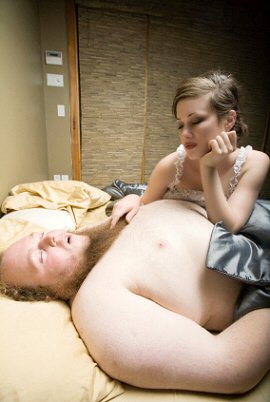
Ugly males more fertile
by Kate Melville

Attractive males release fewer sperm per mating to increase the odds of producing offspring across a range of females, suggesting that couplings with attractive males may be less fruitful than those with unattractive ones. The new findings, published in American Naturalist, are based on mathematical models representing a range of male ejaculation strategies. The researchers, from University College London (UCL) and the University of Oxford, sought to identify the optimum "sperm load" per mating and how this might vary depending on mating patterns.

Previous studies have shown that in animals such as the domestic fowl, and fish such as the Arctic charr, males with privileged access to females produce ejaculations of lower fertilizing quality than subordinate males.

"If a male puts a lot of resources into each mating he will get more offspring per mating, but at the expense of fewer matings. If, on the other hand, a male puts few resources into each mating he will secure less paternity per mating, but will be able to carry out more matings overall. Thus, there is a trade-off between number of matings and success per mating," explained UCL's Sam Tazzyman. "How a male negotiates this trade-off depends on how easy he finds it to attract females. The more attractive a male is, the more females will be willing to mate with him, reducing the value of each mating to him. This means it is optimal for him to contribute fewer sperm per mating. Although this reduces fertility per mating, it maximizes the number of offspring he sires overall. Less attractive males secure fewer matings but value each of them more highly, and by allocating more sperm to each mating make the most of their meager opportunities."

The paper suggested that future work should focus on males that are similarly attractive, but have different levels of resources to allocate to sperm production, to see how this alters their sperm number and quality. Additionally, the researchers say the model should also be expanded to include the effects of short-term sperm depletion and whether the lower fertility of attractive males causes females to start avoiding attractive males that mate too often.

The researchers caution that the results cannot be applied directly to humans. "How this work applies to humans and other primates is not yet known. Human attractiveness is complicated and influenced by a number of factors including cultural preferences. Nonetheless, ejaculate size and sperm quality are likely to have been molded by similar forces, like attractiveness and the number of sexual partners, that are important in other species," concluded Tazzyman.

Related:
Researchers Investigate Giant Sperm Paradox
St Valentine's Day Sperm Massacre
Brainier men have better sperm
Promiscuous Females Make For Competitive Sperm


Source: University College London


Home         All The News      Science Forum         Books, Books, Books         Curiosity Shop         About

The terms and conditions governing your use of this website.
Copyright © 1997 - 2009 Science a Go Go and its licensors. All rights reserved.