
University of Chicago scientists have established that as well as ocean acidification increasing much more rapidly than previously thought, there is also a strong correlation with rising levels of atmospheric carbon dioxide. “Of the variables the study examined that are linked to changes in ocean acidity, only atmospheric carbon dioxide exhibited a corresponding steady change,” said J. Timothy Wootton, the lead author of the study.
Reporting on his team’s work in the Proceedings of the National Academy of Sciences, Wootton noted that while scientists have long predicted that higher levels of atmospheric carbon dioxide would make the ocean more acidic, empirical evidence until now has been limited.
Addressing this deficit, the new study spans eight years and represents the first detailed dataset on variations of coastal pH at a temperate latitude – where the world’s most productive fisheries live. “The acidity increased more than 10 times faster than had been predicted by climate change models and other studies,” Wootton warned. “This increase will have a severe impact on marine food webs and suggests that ocean acidification may be a more urgent issue than previously thought, at least in some areas of the ocean.”
“Many sea creatures have shells or skeletons made of calcium carbonate, which the acid can dissolve,” explained co-researcher Catherine Pfister. “Therefore, the increased acidity of the ocean could interfere with many critical ocean processes such as coral reef building or shellfish harvesting.”
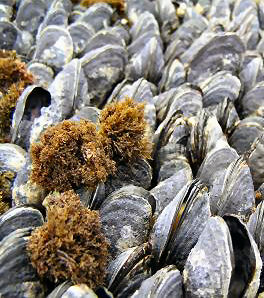
Conducted at Tatoosh Island in the Pacific Ocean off the coast of Washington, the study documented that the number of mussels (pictured) and stalked barnacles fell as acidity increased. At the same time, populations of smaller, shelled species and non-calcareous algae increased.
“Models revealed strong links between the dynamics of species living on the shore and variation in ocean pH,” Wootton said. “The models project substantial shifts in the species dominating the habitat as a consequence of both the direct effects of reduced calcification and indirect effects arising from the web of species interactions.”
“To date there is a lack of information about how the ocean carbon cycle has changed in recent years,” Pfister added. “Atmospheric carbon dioxide concentrations will continue to increase, and our work points to the urgent need to better understand the ocean pH changes that this is likely to drive as well as how these changes will affect marine life.”
Related:
Slimy Future Predicted For World’s Oceans
Alarm Over Rising Acidity Of Oceans
Carbon Dioxide 1, Coral Reefs 0
Climate “Tipping Points” Identified
Source: University of Chicago
Related posts:
 Dire outlook for shellfish in a high CO2 world
 Biofuels could be made directly from excess CO2 in the atmosphere, say scientists
 30ft sea level rise may be unavoidable
 Carbon emission levels from deforestation challenged
 “Profound” plant water cycle changes add new wildcard to climate change guesstimates
 Mars’ missing water


Comments are closed.