

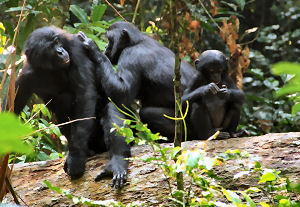
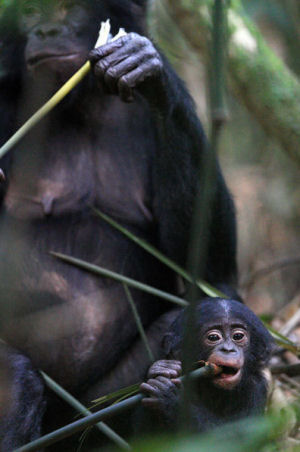
Even when food is plentiful above ground, chimps still choose to dig for roots and tubers, indicating that perhaps our hominid ancestors were not such big meat-eaters after all. Reporting in the Proceedings of the National Academy of Sciences, researchers from the University of Southern California and the University of Wisconsin-Madison say that their work with chimps raises questions about the relative importance of meat for brain evolution.
The study documents the novel use of tools by chimps to dig for tubers and roots in the savanna woodlands of western Tanzania. Researcher Adriana Hernandez-Aguilar says the chimps’ eagerness for buried treats offers new insights in an ongoing debate about the role of meat versus potato-like foods in the diet of our hominid ancestors. The debate centers on the diet followed by early hominids as their brain and body size slowly increased towards a human level. Was it meat-and-potatoes, or potatoes-and-meat? “Some researchers have suggested that what made us human was actually the tubers,” Hernandez-Aguilar said.
The study was based on observation of 11 digging sites in the Ugalla savanna woodland of western Tanzania. Chimpanzees were linked to the excavated tubers and roots through knuckle prints, feces, and spit-out wads of fibers from those underground foods. Seven tools were found at three of the sites, with worn edges and dirt marking implying their use as digging implements.
“Chimpanzees in savannas have not been considered a priority in conservation plans because they live in low densities compared to chimps in forests,” Hernandez-Aguilar noted. “We hope that discoveries such as this will show the value of conserving the savanna populations.”
Related articles:
Missing Link A Tripping Chimp?
Food For Thought
Guess Who’s Coming To Dinner?
Early Humans And Chimps Much More Than Just Good Friends









Comments are closed.