

University of Delaware (UD) researchers have managed to crank up the efficiency of silicon solar cells to a record-breaking 42.8 percent under standard terrestrial sunlight conditions. The new record is an important milestone on the path to the 50 percent efficiency goal set by the Defense Advanced Research Projects Agency (DARPA) under its Very High Efficiency Solar Cell (VHESC) program to develop affordable, portable solar cell battery chargers.
The new results put the pieces in place for a solar cell module with a net efficiency 30 percent greater than any previous module efficiency and twice the efficiency of state-of-the-art silicon solar cell modules. DARPA is initiating the next phase of the development program by funding the newly formed DuPont-University of Delaware VHESC Consortium to transition the lab-scale work to an engineering and manufacturing prototype model.
Given that around 20 percent of the weight of a modern soldier’s pack is batteries, it’s easy to see why the military is interested in the VHESC solar cell. The DARPA program aims to dramatically reduce the battery logistics pipeline and provide the soldier with more power at reduced weight, thus improving mobility, survivability and the availability of power-hungry electronic technologies on the battlefield.
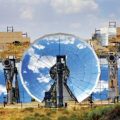
Previous high-efficiency cells used a concentration device that required sophisticated tracking optics, a concentrating lens the size of a table and were more than a foot thick. By contrast, the UD consortium’s devices are far thinner at less than 1 centimeter. The low profile and lack of moving parts translates into portability, which means these devices easily could go on a laptop computer or a rooftop.
“This technology has the potential to change the way electricity is generated throughout the world. This is a solar cell that works,” Barnett boasted, adding that the 50 percent efficiency mark was just the beginning.
Related articles:
Race Is On For Efficient Organic Solar Cells
Study Slams Economics Of Ethanol And Biodiesel











Comments are closed.