
Home   |   Sci News   |   Discussion Forum   |   Books, Books, Books   |   Curiosity Shop
Discussion Forum
Science Talk
Discuss scientific conundrums with our band of bamboozled boffins.
Search
Custom Search
Sponsored Links
Science Shopping
Sci Shop
Peculiar and bizarre scientific stuff that you didn't even know existed and you don't need.
News And Research

Animal Kingdom

Biology

Climate Change

Environment

Evolution

Genetics

Humans

Mind & Brain

Prehistory

Health & Diet

Health Threats

Health & Environment

Health: From The Lab

Mental Health

Reproductive Health

Energy Alternatives

Chemistry

Computing & Electronics

Nanotechnology

Pimping Nature

Robotics & AI

Physics

Space


Science Books
Book Reviews
Rusty Rockets lists his all-time favorite science titles.
Archives
2009 2008 2007
2006 2005 2004
2003 2002 2001
2000 1999 1998
Discussion Archive
Feature Archive


15 June 2007
Glucose Converted Directly To Faux Fossil Fuel
by Kate Melville

A big step towards viable biofuel refining was taken this week, with scientists claiming to have directly converted the natural sugars in plant matter into a promising surrogate for petroleum-based chemicals.

The faux fossil fuel is hydroxymethylfurfural (HMF), which the researchers say can be derived from glucose and fructose. Importantly, the HMF from glucose contains very little of the residual impurities that have made the quest for a viable glucose biorefining method so daunting in the past.

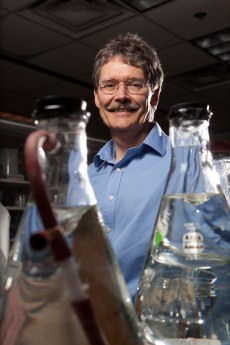
"What we have done is convert glucose directly in high yields to a primary building block for fuel and polyesters," said research leader Z. Conrad Zhang, a scientist at Pacific Northwest National Laboratory. While glucose - found in plant starch and cellulose - is nature's most abundant sugar, Zhang explained that getting a commercially viable yield of HMF from glucose was very challenging. "In addition to low yield until now, we always generate many different byproducts, including levulinic acid, making product purification expensive and uncompetitive with petroleum-based chemicals," he said.

Impressively, the researchers were able to coax HMF yields upward of 70 percent from glucose and nearly 90 percent from fructose while leaving only traces of acid impurities. To achieve this, they experimented with a novel non-acidic catalytic system containing metal chloride catalysts in a solvent capable of dissolving cellulose. The solvent, called an ionic liquid, enabled the metal chlorides to convert the sugars to HMF. Ionic liquids provide an additional benefit: re-use, thus producing none of the wastewater in other methods that convert fructose to HMF.

The metal chlorides belong to a class of ionic-liquid-soluble materials called halides, which work well for converting fructose to HMF, but less effectively with glucose. Working with a high-throughput reactor capable of testing 96 metal halide catalysts at various temperatures, Zhang discovered that a particular metal - chromium chloride - was by far the most effective at converting glucose to HMF with few impurities and at a low temperature of 100 degrees centigrade.

Zhang speuclates that metal chloride catalysts work during an atom-swapping phase that sugar molecules go through called mutarotation, in which an H (hydrogen) and OH (hydroxyl group) trade places. Zhang explained that during the swap, the molecule opens, which allows a hydride transfer through which glucose is converted to fructose.

Zhang's next step is to tinker with ionic solvent and metal halide combinations to see if he can increase HMF yield from glucose while reducing separation and purification cost. "The opportunities are endless," Zhang said, "and the chemistry is starting to get interesting."

Related articles:
Race On To Increase Biofuel Yields
Study Slams Economics Of Ethanol And Biodiesel
Laughing Gas Levels From Biodiesel Crops Not Funny

Source: DOE/Pacific Northwest National Laboratory


Home         All The News      Science Forum         Books, Books, Books         Curiosity Shop         About

The terms and conditions governing your use of this website.
Copyright © 1997 - 2009 Science a Go Go and its licensors. All rights reserved.