
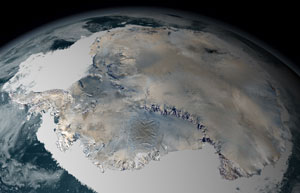
A statement just issued by a gaggle of polar ice scientists has warned that unless we come to grips with the mechanics of Antarctica’s ice sheet bump-n-grind; we may face severe and unexpected consequences from sea level rise. Specifically, the scientists are referring to the West Antarctic ice sheet which contains enough water to lift sea levels by 70 meters. Importantly, the statement has been signed-off by dozens of polar climate experts from both the United States and Europe, making it difficult to discount.
The statement – issued after a three-day meeting at The University of Texas at Austin – points out that ice sheet changes are occurring rapidly in Antarctica and a lack of monitoring facilities means that frustrated scientists are not getting the full picture of what’s happening.
In part, the document seeks to overturn the lack of consensus that was evident in the Intergovernmental Panel on Climate Change’s report in February (see related articles below). To that end, the scientists have compiled a number of points that they say represent the new consensus about what is known about Antarctica’s massive ice sheets.
- Both the grounded ice sheet and the floating ice shelves of the Amundsen Sea Embayment have thinned over the last few decades.
- Ice thinning is accelerating because melting beneath the ice shelves is reducing friction, causing the grounded ice sheet to move more quickly into the ocean.
- Oceanic changes have caused the increased ice-shelf melting. Additionally, recent changes in winds around Antarctica caused by human influence and/or natural variability may be changing ocean currents, moving warmer waters under the ice shelves.
- The possibility that accelerated melting beneath ice shelves will lead to “runaway” thinning of the grounded ice sheet. Current understanding is too limited to know whether, when, or how rapidly this might happen.
The scientists also noted that surprisingly rapid changes were occurring in the Amundsen Sea Embayment, a Texas-size region of the Antarctic Ice Sheet facing the southern Pacific Ocean.
But understanding where all this might lead is next to impossible, say the scientists, thanks to a lack of monitoring infrastructure. The only way to get to grips with the problem, they contend, is to ramp up our observational capabilities. They cite lack of satellite capability, remoteness, a paucity of oceanographic observations and inadequate continental-scale ice sheet models as the main areas that need to be addressed.
Related:
The Group’s Website
Glacier Behavior Confounds Climate Pundits
Antarctic Snowfall Snafu Derails Climate Models
All Hands To The Pumps! Here Comes The Sea
NASA Confirms Recent Ice Sheet Losses







Comments are closed.