Home   |   Sci News   |   Discussion Forum   |   Books, Books, Books   |   Curiosity Shop
Discussion Forum
Science Talk
Discuss scientific conundrums with our band of bamboozled boffins.
Search
Custom Search
Sponsored Links
Science Shopping
Sci Shop
Peculiar and bizarre scientific stuff that you didn't even know existed and you don't need.
News And Research

Animal Kingdom

Biology

Climate Change

Environment

Evolution

Genetics

Humans

Mind & Brain

Prehistory

Health & Diet

Health Threats

Health & Environment

Health: From The Lab

Mental Health

Reproductive Health

Energy Alternatives

Chemistry

Computing & Electronics

Nanotechnology

Pimping Nature

Robotics & AI

Physics

Space


Science Books
Book Reviews
Rusty Rockets lists his all-time favorite science titles.
Archives
2009 2008 2007
2006 2005 2004
2003 2002 2001
2000 1999 1998
Discussion Archive
Feature Archive


14 December 2006
Atom-Smashers Get Peek At Top Quark
by Kate Melville

International physicists have detected for the first time a subatomic particle - the top quark - without the simultaneous production of its antimatter partner. This rare event, set to be reported in Physical Review Letters, could help scientists better explain how the universe works and how objects acquire their mass. The top quark is the heaviest known elementary particle, with the same mass as a gold atom. It does not occur naturally and in this instance was created in the Department of Energy's Fermi National Accelerator Laboratory.
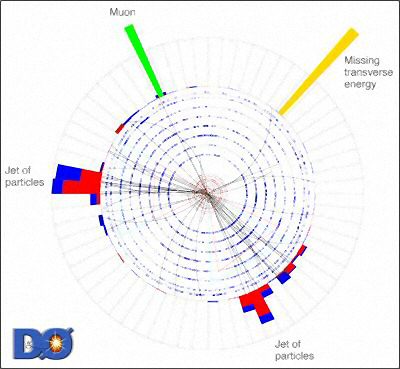
"We've been looking for single top quarks for 12 years, and until now no one had seen them," said the University of California - Riverside's Ann Heinson, the leader of the research team. "The detection of single top quarks - we detected 62 in total - will allow us to study the properties of top quarks in ways not accessible before. We are now able to study how the top quark is produced and how it decays."

The detection of the lone top quark was the result of analyzing data from collision experiments conducted between 2002 and 2005 at the Department of Energy's Tevatron Collider, the world's highest energy particle accelerator. The collisions recorded were those between protons and antiprotons (the antimatter counterparts of protons).

When a proton smashes head-on into an antiproton at velocities close to the speed of light, the collision occasionally produces a top quark. But this unstable particle exists for only a fraction of a second before it decays into lighter particles, thereby complicating its detection. Physicists therefore must look at the top quark's descendents to identify it.

"We detected the top quark using the electronic signature of its decay products," explained Heinson. "We measured the position of charged particles using a silicon vertex detector, which is an instrument - first encountered by the particles after the collision - that can precisely reconstruct the trajectories of charged particles. Since theory predicts single top quark production, we knew what to look for. It was extremely difficult, however, to find."

Source: University of California - Riverside


Home         All The News      Science Forum         Books, Books, Books         Curiosity Shop         About

The terms and conditions governing your use of this website.
Copyright © 1997 - 2009 Science a Go Go and its licensors. All rights reserved.