

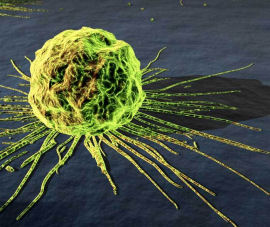
The dynamics of evolution are as evident in cancerous tumors as in any other ecosystem and oncologists hope that with help from ecologists and evolutionary biologists, they can exploit natural selection to develop radical new cancer treatments.
“A tumor cell population is constantly evolving through natural selection,” says Wistar Institute researcher Carlo C. Maley, who is the senior author of a review paper appearing in Nature Reviews Cancer. “The mutations that benefit the survival and reproduction of cells in a tumor are the things that drive it towards malignancy.
Maley’s paper notes that tumor cells satisfy the three conditions necessary for natural selection to occur; there is variation in the population, the variation must be heritable, and the variation affects fitness (the survival and reproduction of the cells). Maley contends that seeing a tumor in this light creates the possibility for new therapeutic strategies. “It’s not just a metaphor to say tumor cell populations are evolving,” he says. “Evolution is going on in the tumor. So let’s think about how we might want to influence that evolution. Can we push it down paths that might be more beneficial to us?”
One such idea might be to develop new drugs that would act as benign cell boosters. These drugs would specifically target the more benign cells in a tumor to increase their relative fitness over their malignant neighbors. This would allow the benign cells to out-compete the malignant cells, leading to a less aggressive, less dangerous tumor. “Another idea is what we call the sucker’s gambit,” Maley says. “In this case, you try to increase the fitness of chemosensitive cells so that they out-compete any resistant cells that are in the tumor. And then you apply your chemotherapy. So you sucker the tumor into a vulnerable state and then you hit it with your therapy.”
Interestingly, evolutionary concepts like parasitism and mutualism are apparent in cancer biology. Parasitism can be seen in cancer angiogenesis, in which a subset of tumor cells send chemical signals to stimulate the host to generate new blood vessels to supply the tumor with nutrients. The neighboring cells that aren’t investing resources in producing the signals take advantage of the nutrients nonetheless. Mutualism describes how tumor cells send signals to stimulate the growth of the cells that form the scaffold in which the tumor cells grow, known as fibroblasts. The fibroblasts, in turn, send signals to the tumor cells to stimulate their growth. Recent studies suggest, too, that the fibroblasts in a tumor microenvironment begin to acquire mutations of their own. “They’re co-evolving, and it becomes a dynamic, runaway process,” Maley says.














Comments are closed.