

Researchers from the Children’s Hospital Boston say they have the strongest evidence yet that sudden infant death syndrome (SIDS) is not a “mystery” disease, and in fact has a concrete biological basis. Published in the Journal of the American Medical Association, the study documented abnormalities in the brainstem of babies who died from SIDS.
Past studies have identified various risk factors for SIDS, such as putting babies to sleep on their stomachs, but until now there has been little understanding of SIDS’s biologic basis. The new insights came about thanks to brain autopsy specimens from infants who had died from SIDS; specifically, the lowest part of the brainstem, known as the medulla oblongata, which controls breathing, blood pressure and body heat. The researchers say they found abnormalities in serotonin levels there, a chemical that transmits messages from one nerve cell to another.
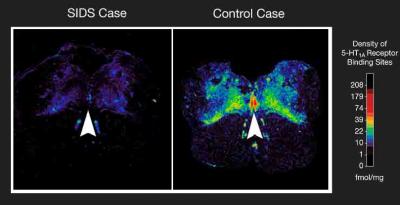
The researchers speculate that the abnormalities they observed begin during early fetal development, and that prenatal affronts like maternal smoking and alcohol use may adversely affect development of the brainstem serotonin system during this time. While more research is needed to explain exactly what causes the abnormalities and how they can be prevented, Kinney and her colleagues hope to develop a diagnostic test to identify infants at risk for SIDS. They also envision a drug or other type of treatment to protect infants who have abnormalities in their brainstem serotonin system.
Source: Children’s Hospital Boston
Graphic courtesy David Paterson, Ph.D., Children’s Hospital Boston
Related posts:
 Zoloft appears to alter brain structures, say U.S. researchers
 Link between serotonin and depression is a myth, argues leading psychiatrist
 Software scans family photos to diagnose rare disorders
 Tourette’s Sufferers Enjoy Superior Grammar Skills
 Synthetic genome successfully transplanted into cell
 Light Shed On How The Brain ‘Thinks’











Comments are closed.