Home   |   Sci News   |   Discussion Forum   |   Books, Books, Books   |   Curiosity Shop
Discussion Forum
Science Talk
Discuss scientific conundrums with our band of bamboozled boffins.
Search
Custom Search
Sponsored Links
Science Shopping
Sci Shop
Peculiar and bizarre scientific stuff that you didn't even know existed and you don't need.
News And Research

Animal Kingdom

Biology

Climate Change

Environment

Evolution

Genetics

Humans

Mind & Brain

Prehistory

Health & Diet

Health Threats

Health & Environment

Health: From The Lab

Mental Health

Reproductive Health

Energy Alternatives

Chemistry

Computing & Electronics

Nanotechnology

Pimping Nature

Robotics & AI

Physics

Space


Science Books
Book Reviews
Rusty Rockets lists his all-time favorite science titles.
Archives
2009 2008 2007
2006 2005 2004
2003 2002 2001
2000 1999 1998
Discussion Archive
Feature Archive


17 October 2006
Scientists Create Super-Heavy Element 118
by Kate Melville

Scientists from Lawrence Livermore National Laboratory, in collaboration with researchers from Dubna, the Joint Institute for Nuclear Research (JINR) in Russia, have welcomed the newest super-heavy element, element 118, into the world. Using JINR's U400 cyclotron, the researchers established the existence of element 118 using atomic decay patterns. The decay patterns reveal that the previously observed element 116 is produced via the alpha decay of element 118.

Writing in the journal Physical Review C, the researchers said they produced three atoms of element 118 when they bombarded a californium target with calcium ions. The team then observed the alpha decay from element 118 to element 116 and then to element 114. The researchers had created the same isotope of element 116 in earlier experiments. This latest discovery brings the total to five, of new elements found by the Livermore-Dubna collaboration (113, 114, 115, 116 and 118).
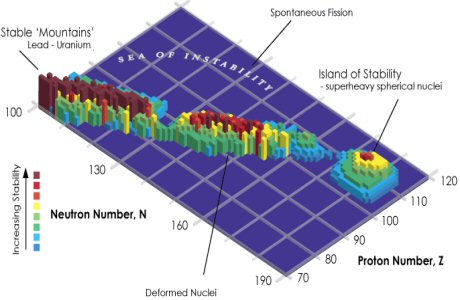
"The decay properties of all the isotopes that we have made so far paint the picture of a large, sort of flat 'Island of Stability' and indicate that we may have luck if we try to go even heavier," enthused Ken Moody, Livermore's team leader.

The "Island of Stability" describes the possibility of elements which have particularly stable "magic numbers" of protons and neutrons. This would allow certain isotopes of some transuranic elements (elements with atomic numbers greater than 92) to be far more stable than others, and thus decay much more slowly.

Element 118 is expected to be a noble gas that lies right below radon on the periodic table of elements. "The world is made up of about 90 elements," Moody said. "Anything more you can learn about the periodic table is exciting. It can tell us why the world is here and what it is made of."

The LLNL-Dubna team will continue to map the region near the "Island of Stability." In 2007, the team plans to look for element 120 by bombarding a plutonium target with iron isotopes. "The heavy element community will continue to search for new elements until the limit of nuclear stability is found," said researcher Mark Stoyer. "It is expected that limit will be found."

Watch an animation from Livermore

Source: Lawrence Livermore National Laboratory
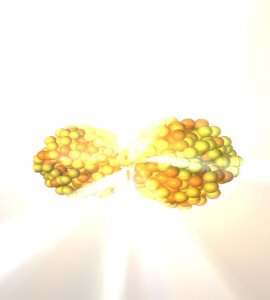
Pic courtesy Lawrence Livermore National Laboratory


Home         All The News      Science Forum         Books, Books, Books         Curiosity Shop         About

The terms and conditions governing your use of this website.
Copyright © 1997 - 2009 Science a Go Go and its licensors. All rights reserved.