
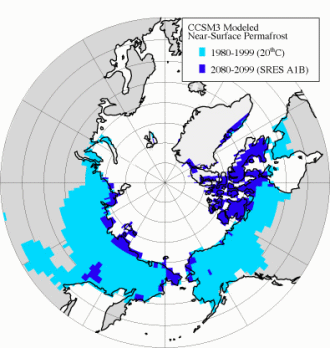
Earth’s warming climate looks like it could thaw 90 percent of the perennially frozen soil across the Arctic by 2100, altering ecosystems and damaging infrastructure across Canada, Alaska, and Russia. Additionally, the effects of so much carbon being released into the atmosphere could massively increase the rate of climate change. These dire predictions, from the National Center for Atmospheric Research (NCAR), appear in the journal Geophysical Research Letters.
NCAR’s study, using what it calls the Community Climate System Model (CCSM), is the first to examine the state of permafrost in a global model that includes interactions among the atmosphere, ocean, land, and sea ice as well as a soil model that depicts freezing and thawing. “People have used models to study permafrost before, but not within a fully interactive climate system model,” says NCAR’s David Lawrence, the lead author of the study.
Lawrence explained that about a quarter of the Northern Hemisphere’s land contains permafrost (soil that remains below 32 degrees Fahrenheit for at least two years). Permafrost is typically characterized by an active surface layer, extending anywhere from a few centimeters to several meters deep, which thaws during the summer and refreezes during the winter.
The effects of recent warming and degraded sections of permafrost can be seen across central Alaska, where pockets of soil collapse as the ice within it melts. The results include buckled highways, destabilized houses, and “drunken forests” – trees that lean at wild angles. In Siberia, some industrial facilities have reported significant damage.
While the damage to wilderness areas and infrastructure is bad enough, the effects from the water run-off and freed carbon could be even more severe. “Thawing permafrost could send considerable amounts of water to the oceans,” said co-researcher Andrew Slater, who notes that runoff to the Arctic has increased about 7 percent since the 1930s. It’s possible that runoff could grow by another 28 percent by the year 2100. That increase includes contributions from enhanced rainfall and snowfall as well as the water from ice melting within soil.
The biggest effect on climate, however, could come from the emissions of greenhouse gases from thawing soils. The permafrost may hold 30 percent or more of all the carbon stored in soils worldwide and as the permafrost thaws, it could lead to large-scale emissions of methane or carbon dioxide far beyond those produced by fossil fuels. “There’s a lot of carbon stored in the soil,” concluded Lawrence. “If the permafrost does thaw, as our model predicts, it could have a major influence on climate.” Lawrence and others are now working to develop a more advanced climate model that includes carbon factors.












Comments are closed.