
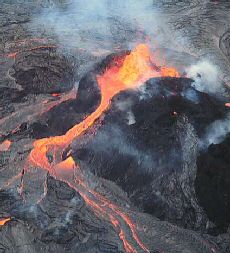
The world’s largest mass extinction occurred some 250 million years ago, wiping out 90 percent of marine life. While some scientists have speculated that an asteroid impact might be to blame, the cause of this great dying has remained a mystery. But a new study published inGeology provides evidence that the cause of the extinction did not come from the heavens, but from the Earth itself.
A team of scientists led by Christian Koeberl from the University of Vienna have been studying rock samples taken from mountain ranges in Western Europe. The layers of rocks contain a record of environmental change though time. Asteroids and comets are chemically different from the Earth and when these objects arrive they leave a tell-tale chemical fingerprint in the rocks. Koeberl confirmed the presence of the element iridium in the samples. Iridium is abundant in asteroids, comets, and other extraterrestrial material. However, the amounts found were very small compared to those associated with the asteroid impact that many scientists believe killed off the dinosaurs 65 million years ago. At the same time, the team found no traces of the extraterrestrial isotopes helium-3 and osmium-187, commonly associated with impact events.
What the team found was evidence of purely terrestrial processes at work. According to Koeberl, “The slight concentrations of iridium may have been deposited by sluggish oceans when atmospheric carbon dioxide levels were high and seawater oxygen levels were low. The source of the carbon dioxide was probably volcanic activity.”
The researchers say that massive volcanic activity in the heart of present day Siberia led to changes in climate and patterns of oceanic circulation. “Our findings support the view that evidence for an extraterrestrial impact event during this time period is weak and inconsistent,” said Koeberl. “At the same time, they suggest that widespread volcanic activity may have been the ‘smoking gun,’ quite literally, that wiped out much of life on Earth.”







Comments are closed.